
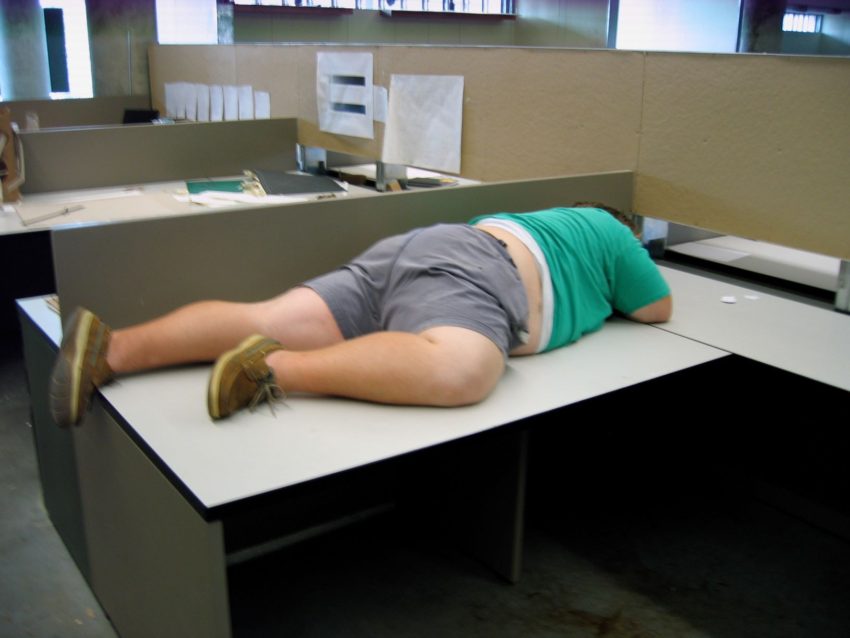
Architecture school has a reputation for having a uniquely time-consuming curriculum. In my own experience, the stigma held true: the workload was insane. Indiana University’s 2016 “National Study of Student Engagement” concluded that architecture is the single most time-consuming major in the galaxy. Architecture students spend, on average, 22 hours a week on schoolwork outside of their classes. So in this post, here’s what we’re gonna do:
- First we’re going to break down why architecture is so time consuming.
- Then we’re going to look at why a student might think the all-nighter is the correct response to the workload.
- Finally, we’re going to refute the “logic” of pulling an all-nighter as a way to get more done.
First things first. Why is architecture so absurdly time-consuming? There are many reasons. Here are some big ones:
- Architecture is a creative field. When you design something, you are, among other things, trying to make it look good – or even beautiful. The beauty (or venustas for all you Vitruvius OG’s out there) of your design is subjective. It’s not a 2+2=4 situation. Take a studio project for example. While there are admittedly some cut and dry objective aspects at play (zoning, building codes, budget, ADA requirements, etc.), you’re also trying to make your project beautiful. The problem is it’s hard to make something beautiful. Like really hard. You’ll probably never achieve anything like aesthetic perfection where all the materials, proportions, colors, and formal gestures meld in just the right way. But THAT SAID, just as the curve approaches the asymptote but never arrives, you too can be the little curve that could and iterate and reiterate in the pursuit of perfection. BUT producing multiple iterations is a major time-suck. Speaking of suck, you’ll take a first stab at your design and *drumroll please* … it will suck. Then you make some adjustments, fix some problems, tweak some things and produce a second iteration. It will still suck, but just a little less this time. So you repeat, repeat, repeat. You could do this until the end of time.
- There is a heavyyy learning curve for picking up all the software you need to know to assemble a presentation. If you are a software noob like I was, this can be a time black hole – especially in the beginning.
- Physical models. These are tedious. To execute a high level of craft, you need to be methodical and precise. This takes time and patience. Lots. There’s no getting around it.
Ok, we get it: architecture is time-consuming af. But how do we handle this? An all-too common response is to pull the infamous architecture school all-nighter. I’m speaking (errrr….typing) from experience. I pulled all-nighters frequently. Many times each semester. That said, I strongly advise against it. Classic “do as I say, not as I do” situation.
Let me first lay out the case for staying up all night before I debunk the rationale:
There are two primary reasons why you might pull an all-nighter when you have too much to do and not enough time in which to do it:
Reason #1: You procrastinated. Don’t do that.
Reason #2: You give a shit.
If you give a shit, you’ll put in the time until time is up. Those who don’t care say “fuck it” and fold, and go to bed when they get tired. It’s easy to tell who gives a shit and who doesn’t. Those of us who give a shit will repeat the iterative process all the way to the deadline, trying to make the project better, better, better. And even then, of course, the design is still not “finished.” We always need more time. Always. But time is finite, and you might feel the all-nighter is your best bet to cheat the system and steal the nighttime hours in your favor. You’ll sacrifice your sleep because you care about doing well; because you’re passionate about architecture; because you want to design an excellent project that looks fantastic; because you want to be the best student that you can be. That was my rationale.
*Now for the debunking *
I get it. I get the desire to do well. I get the grit and willingness to put in extra effort. But the truth is, despite your best intentions, by depriving yourself of sleep, you’re actually being directly counterproductive to what you’re trying to accomplish. You are hurting yourself. If you really cared about doing well and all that other stuff, you would prioritize restful sleep. Though the purpose of the all-nighter is to gain more time to make your project better, the insidious little secret is that you net-lose more time than you would have by just going to bed at a reasonable hour. This is for a variety of reasons. For one, your mental acuity starts decreasing rapidly at a certain point. For me, this was usually around the 2:00 a.m. mark. When you get 2:00 a.m. tired, you’re not nearly as efficient, the quality of your work is generally not as good, and you make more mistakes. But the real problem is the next day. If you attempt to stay awake throughout the entire next day, let’s face it – you’ll basically be a worthless shell of a person – both physically and mentally. Even if you can muster the will-power to sit through classes, though through some miracle your ass has made it into your classroom seat, you’re mentally not there at all. You’ll have the short term memory and attention span of a mentally challenged mosquito, and you’ll be in absolute misery. When it comes to actually doing productive, creative work, forget it. You might sit there and try, but it’s futile.
Maybe your plan is to take a nap the next day, to even things out. But even the most disciplined, well-meaning human beings are fallible, and what might be intended as a brief snooze almost inevitably turns into a deep slumber (during which you might miss other classes or other important things). And then when you randomly wake up at 4:00 in the afternoon, your sleep schedule is destroyed and you probably won’t be able to go to bed the following night. And the horrific cycle is likely to repeat itself.
If you’re still not convinced, here are 2 more strong reasons not to pull all-nighters:
- If you’re sleep deprived during a review, your presentation will not be as good as the fully-rested version.
- Arguably the highest quality feedback you get in your architecture school career comes during final reviews. You have your professor & a jury of professionals giving thoughtful customized feedback, responding directly to your project and presentation. Your faculty and members of the jury are (usually) rich sources of invaluable information. If there’s any time that you need to be mentally awake, this is it. If, however, you didn’t sleep a wink the previous night, you won’t be able to optimally internalize their valuable insight. This just isn’t worth putting in an extra 8 hours of work on your project. Not only will you miss out on quality feedback for your own work, but you also won’t benefit from hearing their commentary on other projects. This is a terrible, terrible waste. Throughout essentially my entire education I spent final review days hanging onto sanity and consciousness by a thread because I’d stayed up all night working instead of sleeping. I deeply regret this.
The take-away: If you give a shit and you want to do well, the goal is to maximize and optimize productive hours. This means when you are awake, stay focused and get shit done. By going to bed early, you’re setting yourself up for an efficient, optimized next day. The more alert/awake/productive hours you have to work on your project, the better it will be. Even if you physically spend more time working on something by habitually staying up late, you are decreasing the amount of optimized hours. You are shooting yourself in the foot. Don’t shoot yourself in the foot. It will be painful, and it will make you look stupid.