
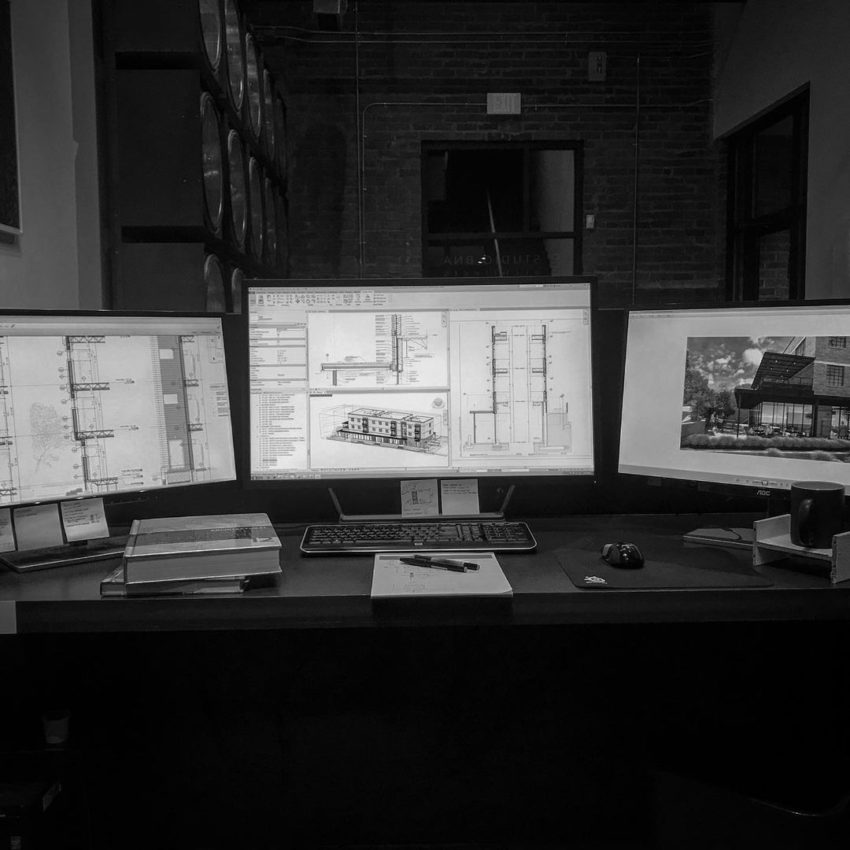
What’s a day in the life of an architect like?
When I was in school, one of my most burning questions was “what do real architects do on a daily basis at work?” Throughout school I had the sneaking suspicion that a lot of the stuff we were doing in the classroom would not be directly relevant in a professional architecture firm. No joke – my worst fear was that I would kill myself getting through school, and then not have the skills necessary to get hired in the real world – or, even if I did get hired, wouldn’t be able to contribute in a meaningful way. Now that I’ve been out of school for a few years, and have worked in four very different firms, I have some valuable perspective on those early fears, and on what architects do on the daily.
There is an incredible breadth to the practice of architecture. Contrary to popular opinion, “architect” is a very broad term. There is no such thing as a universal typical day at the office. It all depends on where you work, what kind of projects your firm focuses on, how much experience you have, and what your individual role is. Depending on how these factors shake out, a day in the life at one office could look dramatically different than a day at another. Some architects draw, some don’t; some interface with clients, some don’t; some use Revit, some don’t; some design, some don’t. I think you get the picture. When someone tells me they’re an architect, although that may at least hint at what they might do, I need way more information before I have a nuanced understanding of what they actually do.
You might find this surprising. I did. I feel like most people think all architects spend all their time designing and making beautiful drawings and models. Yes – from time to time we do those things (even if sometimes they’re not beautiful); but most of the time, we’re doing far less glamorous tasks. I know architects who do little to no design…who never produce sketches…who never produce cool physical models. Conversely, I know of some architects out there who actually do fit the archetype (though this tends to be far more rare). All this is to say it’s impossible to give you an all-encompassing snapshot of what it’s like to be an architect. What I can do, though, is give you a snapshot of what a typical day at my firm is like. This way you’ll have at lease some idea of the kinds of things you might be asked to do in a professional office. So without further ado, here it is – a day in the life:
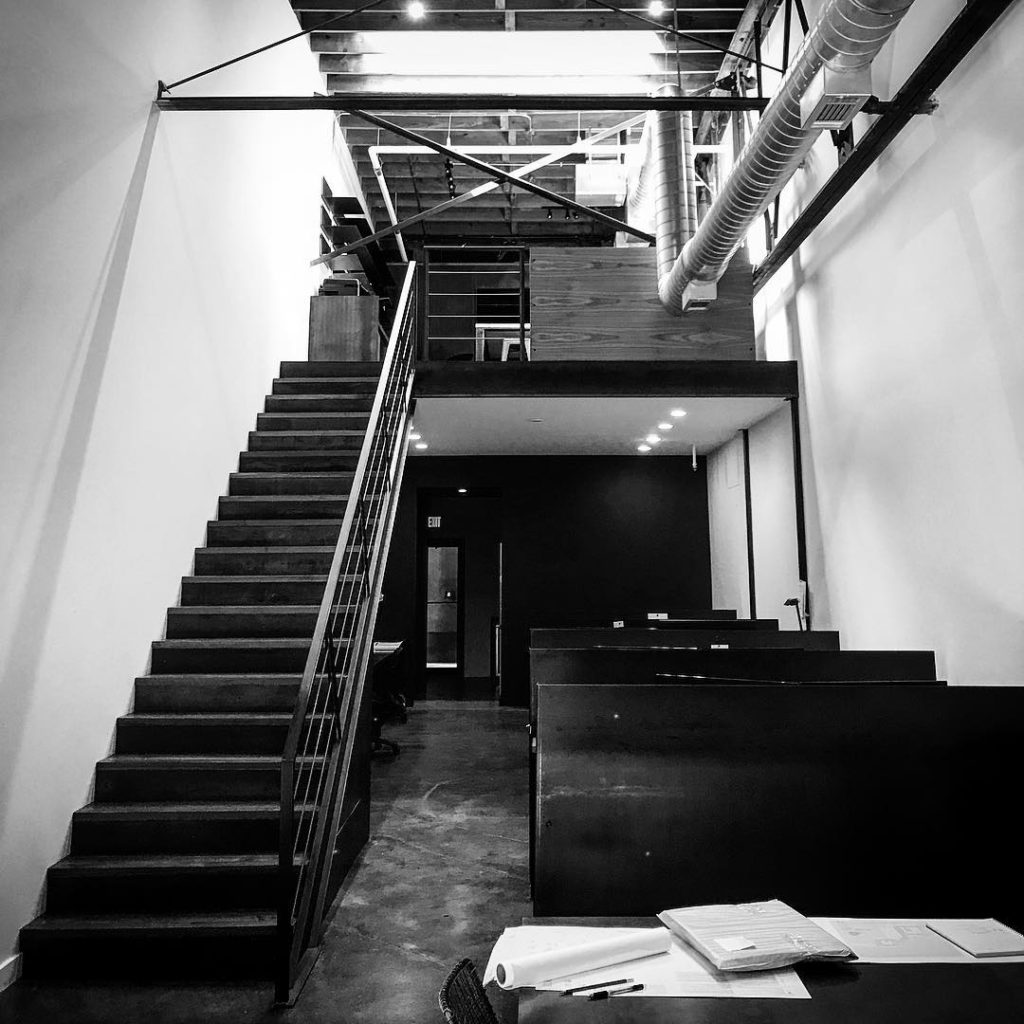
Our official work hours are 8:00 to 5:30ish. Though 9:00 to 5:00 is standard for many jobs, the slightly extended work day seems to be pretty normal for our industry. I’m at a small firm. We’re a 9 man…. errrr… 6 man, 3 woman team. The first thing I do every day is boot up Revit, open up my email, and make a beeline for the Keurig machine. At any given time, I’m involved in a handful of projects. I’m the project manager for some, and play a support role for others. Since we’re so small, everyone does a little bit of everything & nobody is pigeon-holed doing some absurdly boring task on repeat.
Construction Documents
I spend most of my time working on construction documents (CDs’) – that is, documenting the building through drawings for the purpose of obtaining a permit. Any given set will include plans, sections, elevations, and details. At the beginning of a project, after the schematic design has been approved, I generate a 3D “CD” model in Revit. We use the model as a base from which we create the 2D drawings. I know a lot of architects who loathe doing this kind of production work. It’s never explicitly said, but it’s clear that some regard CD soldiers as the grunts of an office. Despite this, I genuinely enjoy producing drawings. My ultimate goal is to eventually be able to take on a project – from soup to nuts – all by my lonesome. When you draw a building, you’re forced to understand how it’s actually built. If I don’t know how something goes together, I either ask someone else in the office with more experience or research it on my own. Inevitably, by drawing, you learn an incredible amount about construction. It forces you to think things through. All told, I spend probably about 75% of my time at the office working on CD’s. The work that accounts for the other 25% varies, and is a function of whatever happens to be on our firm’s plate at any given time. Here are some examples of other things I routinely work on:
Renderings
If we have a new project, sometimes I’ll have to produce a rendering of the initial design concept to make sure the client and city are on board with what we’re thinking. This entails modeling the design in Revit, using the V-Ray for Revit plugin to actually do the render, and then post-processing in photoshop. Our principal typically generates the big-picture moves of a design, but we have a fair degree of autonomy in adding details and making fine-tuned adjustments along the way. In some cases, we have significant influence over even the big-picture stuff. I’m often completely responsible for the design of smaller elements like canopies, trellises, corbeling details, coping profiles, head/sill/jamb details, etc. Here are a couple of renderings I recently produced:


Code Research
I routinely conduct code research – both in terms of the IBC and local building ordinances – to ensure that the design we’re proposing is compliant with existing laws. These codes define, among other things, how many stories a building can be, what materials it can be made of, what the insulation requirements are, how big the footprint can be, blah blah blah. The major code items are critical to get right early on.
I’ll warn you that the code can be intimidating. The International Building Code is a 726 page book that is full of very dense information. Just getting acquainted with where to look for something takes a while to get the hang of. When you’re looking for something specific in the code, you often get bounced around like a plinko ball to a million different sections before you find what you’re looking for. One passage references another, which references another, and on and on. The worst part is that sometimes, even when you find what you’re looking for, the information seems ambiguous and open to interpretation. I don’t know how most people feel, but a deep dive on a code question tends to completely zap my energy.
Seeing this image always triggers me:

The IBC is produced by the International Code Council. You can check out their website here:
Structural Coordination
This is something I’ve only started doing at my current firm. It’s been surprisingly enjoyable. I like it for the same reason that I enjoy CD’s: through this process, I learn an incredible amount about construction. Coordinating with engineers is a back and forth process that lasts the entire duration of a project. Most of the structural engineers we work with use the same software we do (Revit) – which is tremendously helpful, because it allows us to integrate our 3D models. As soon as we get our design modeled, we shoot it to the structural team, and they use it as a background to produce their 3D model. They then send us theirs, and we link it directly into ours. Though it sounds like a process that might be ripe with complications, so far it’s actually been pretty smooth. After I have a combined model to gander upon, I look around the building and make a list of all conditions that I need to discuss with the structural team. This marks the beginning of an ongoing collaborative effort to get the building completely figured out. We’re constantly communicating to make sure we’re on the same page about everything. Some examples of questions I might typically have for the structural engineers are: What is our foundation system? How thick is our slab? What are the size of our footings and how deep are they buried? Do we need a shelf angle for our masonry? If so, what size, where are we putting it, and what is our method of attachment? What do our headers need to be? Are we using loose lentils to support our brick, or will the lentils tie back into the structure? The list goes on and on. Through this process, we can solve a lot of problems on paper prior to construction, that would otherwise (far less ideally) have to be figured out in the field.
Construction Administration
This one is my least favorite. For a project where I’m the project manager, I act as our firm’s representative during the construction phase. That means I have to go to periodic OAC (owner, architect, contractor) meetings where I sit down with the owner and contractors to discuss how progress is going and any issues that might come up along the way. I’m severely introverted by nature, so these meetings are terribly uncomfortable for me. But hey, sometimes you’ve gotta do things that you don’t want to do.
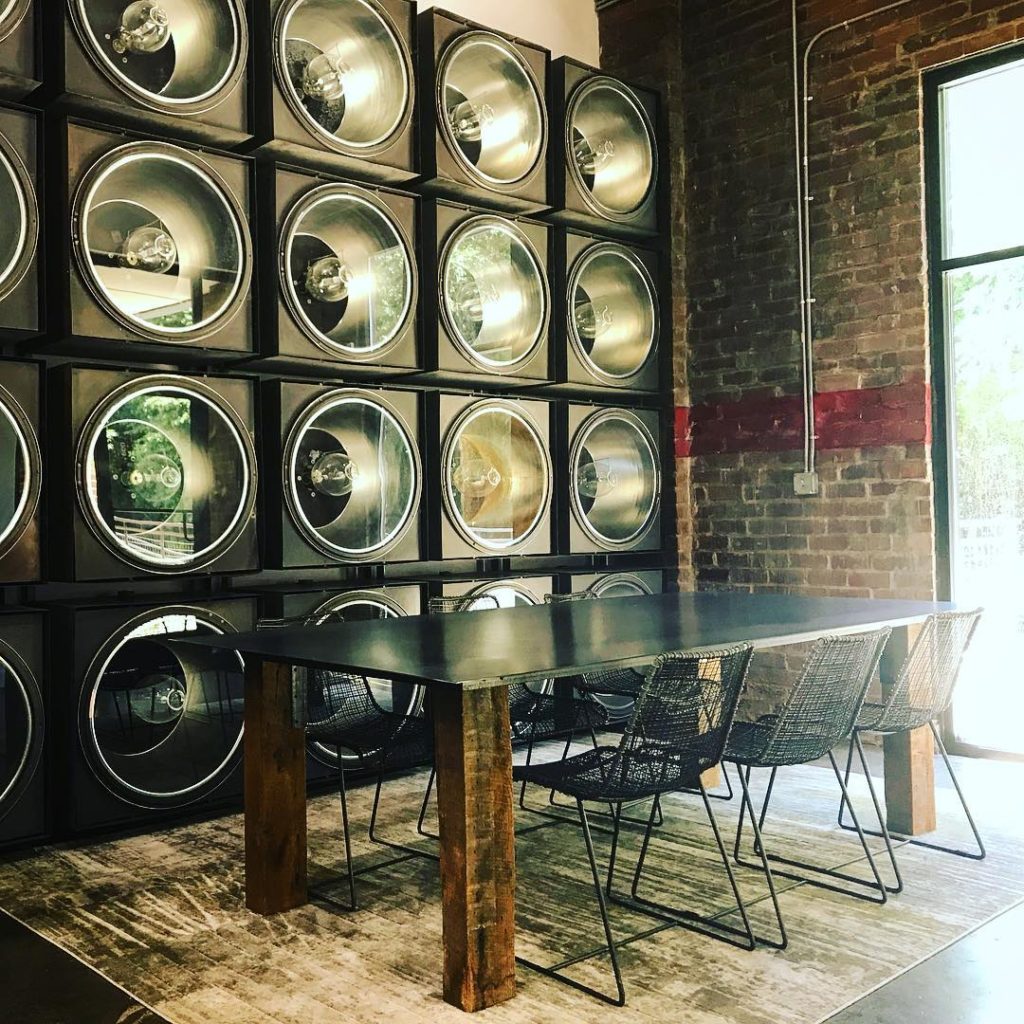
Miscellaneous
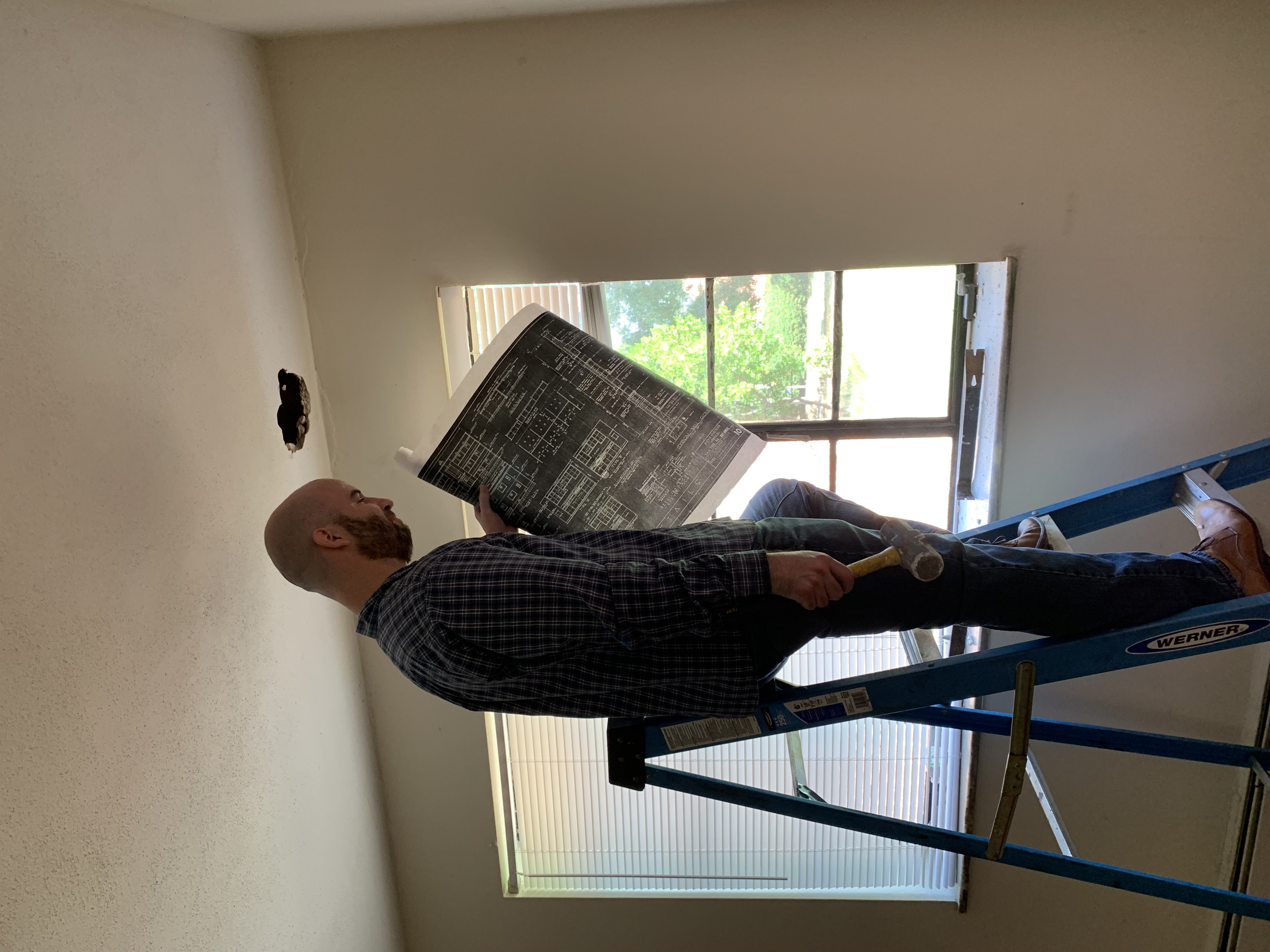
In addition to these tasks, I do small things here and there and fill in anywhere that I’m needed. The following are some examples of random things I’ve had to do, and are indicative of the kinds of things you might be called upon to do on any given day: Go to the field to measure an existing building, & come back to model it in Revit; produce a BOMA (Building Owners and Managers Association) area plan for an owner; look up parking requirements for a project & count to make sure we’ve provided enough spaces; complete a fire & life safety plan for someone else’s project; produce a plan or rendering to be used for marketing/leasing purposes; knock a hole in the ceiling of an old existing building to see how the joists are bearing on the wall.
There are plenty things I’m leaving out, but this paints a pretty good picture of the types of things I regularly do. You know what the cool part is? Other than the design sensibility, I’ve learned everything else on the job. The majority of what I do every day was not explicitly taught in school, and this is absolutely typical. If you’re fresh out of school, your potential employers know you have a very limited base of knowledge, and that there’s plenty you don’t know and can’t yet do. But don’t sweat it; if you make it through school, you are qualified for an entry level position in a firm. Period. As long as you continue to work hard and apply yourself post-graduation, you’ll eventually develop the skill set and abilities you’ll need to be a valuable contributor to your team – no matter what your own day in the life looks like.