
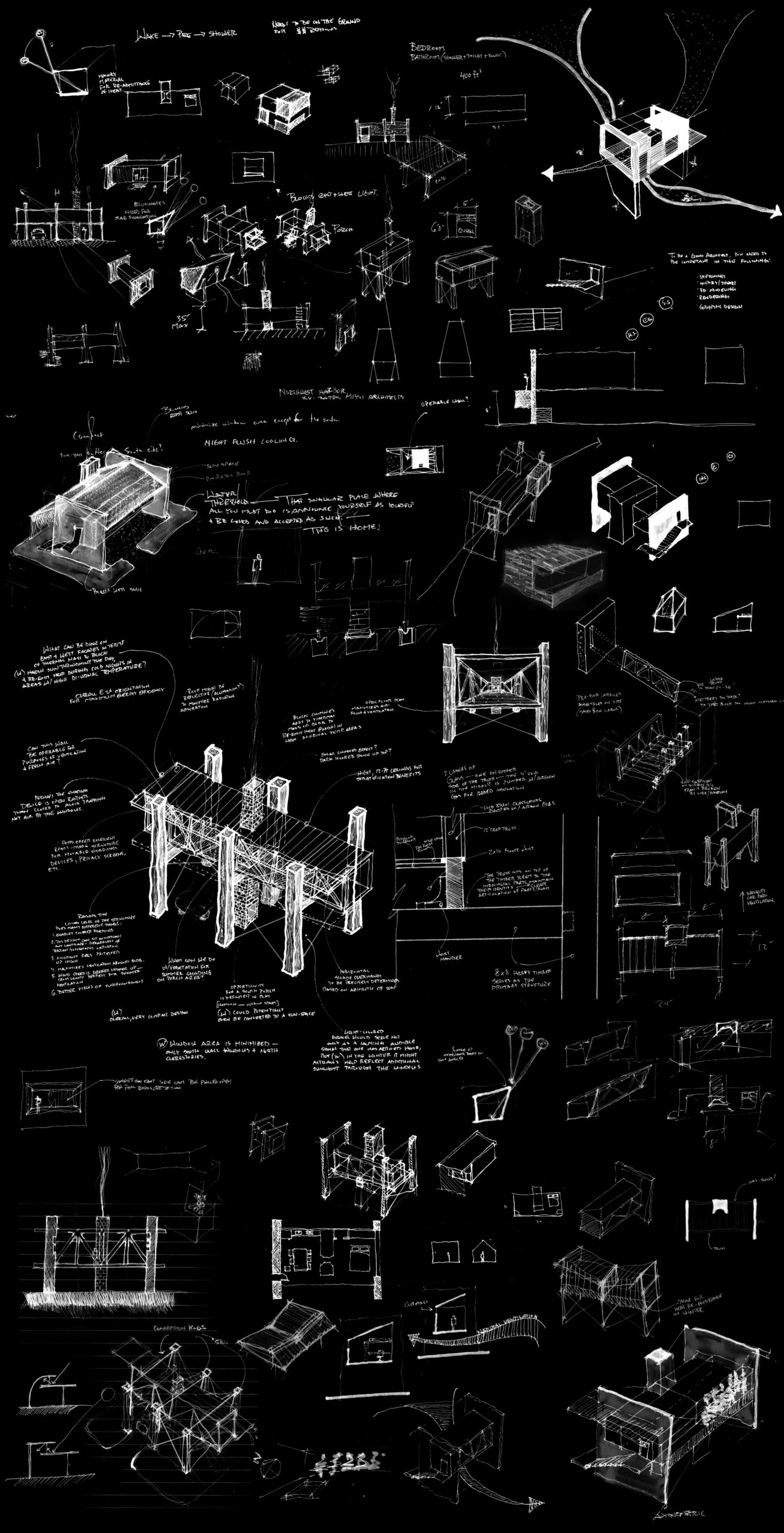
In this post, I’ll address the age-old question: “Do you have to be good at drawing to be an architect?” (Skip to the summary at the end if you want the super succinct answer without all the mumbo-jumbo)
To avoid confusion, first let’s define two broad categories of architectural drawing:
1: TECHNICAL DRAWINGS. These are precise drawings you’ll routinely prepare for construction documents – things like plans, sections, elevations, axons, etc. They are essentially instructions for how to construct a building.
2: SKETCHING. Sketches are typically informal and quick, and used (among other things) to generate ideas, convey design intent, or solve problems. They’re often highly stylized & usually not intended as polished finished products.
As an architect, you’ll need to become proficient at technical drawings, but not necessarily sketching.
More about technical drawing
The good news is that the ability to prepare professional technical architectural drawings is 100% a learned skill. Re-read that sentence. You can enter architecture school with no drawing background whatsoever (like I did) and still leave with all the drawing skills you’ll need to land a job.
You can enter architecture school with no drawing background whatsoever and still leave with all the drawing skills you’ll need to land a job.
Becoming proficient at this kind of drawing is mostly about implementing standards correctly. Things like: If you cut through something, it gets a dark line. If you want to show something that is hidden behind an object, dash it in. If a drawing is cut off, you need a break line. Furniture gets light lines. Boom boom boom. Learn the rules, implement them, and by the time you graduate, you will be a competent technical drawer.
Caveat
That said, just because there are objective technical standards, it doesn’t mean there’s not also room for artistic expression. All legitimate architecture firms can produce drawings that follow the rules. That’s the baseline. However, the style and graphic standards of the drawings can vary (sometimes dramatically) from firm to firm. There are many factors at play here. For example, do you show shadow in your elevations? How intense are they? Precisely which line weights do you use for different elements, and how intentional are you about their relationship to each other? How much context do you show? Do you even hatch, bro? The considerations go on and on. Although technical drawings are often perceived as relatively ‘dry,’ there’s actually quite a bit of juicy design sensibility at work in these as well.
Pro Tip
How a firm draws, the graphic standards they implement, and the artistic feel of their drawings speaks volumes about their core values. It’s incredibly telling. When interviewing for a job, ask if they’ll show you one of their recent permit sets. If it the graphics are terrible, smack the drawings out of their hands, smack their faces, and walk out.
More about sketching
Sketching is a different beast. If you work in a firm, you’ll be expected to routinely prepare technical drawings, BUT! (depending on where you work) there’s almost certainly not the same expectation for sketching. I’ve worked with plenty of architects who – even after years of school and half a lifetime in the profession – have basically no sketching ability whatsoever. In the ever-increasing digitalization of our profession, this form of drawing, sadly, is a dying art.
What a shame. Though it’s not a crucial skill for landing a job, it’s one of the most important tools in the creative process.
When you sketch, there’s a direct link between mind and hand. You have a thought, and it’s immediately manifested in the physical world. And you can riff on it. It’s an excellent way to figure stuff out – to test possibilities – to quickly discard ideas that don’t work – to explore. Sketching is like the jazz of architectural drawing. You think, make a mark, adapt, refine, draw over, transform. And it’s done quickly. When you really get caught up in it, your hand will struggle to keep up with your mind. Everything is stream of consciousness. You’re not concerned with making mistakes or getting things perfect. You just go. It’s wonderful.
Caveat
But it’s not all cherry blossoms and roses from the jump. To arrive at the point where you feel this kind of pleasure through sketching, you must practice. A lot. When you first start out, if you’re like me, you’ll hate everything you draw. You’ll tell yourself you simply don’t have the requisite talent, you won’t be able to learn, and you just can’t do it. You’re not alone! Everyone feels this way in the beginning. What you produce early on will discourage you. There’s no avoiding this, but it’s just part of the process. I was the world’s worst sketcher coming into architecture school. I’m still not good, but I’ve improved immensely by sticking with it. Don’t believe me? Here’s proof. The sketch on the left is from my first year in school. The sketch on the right is from my senior year.
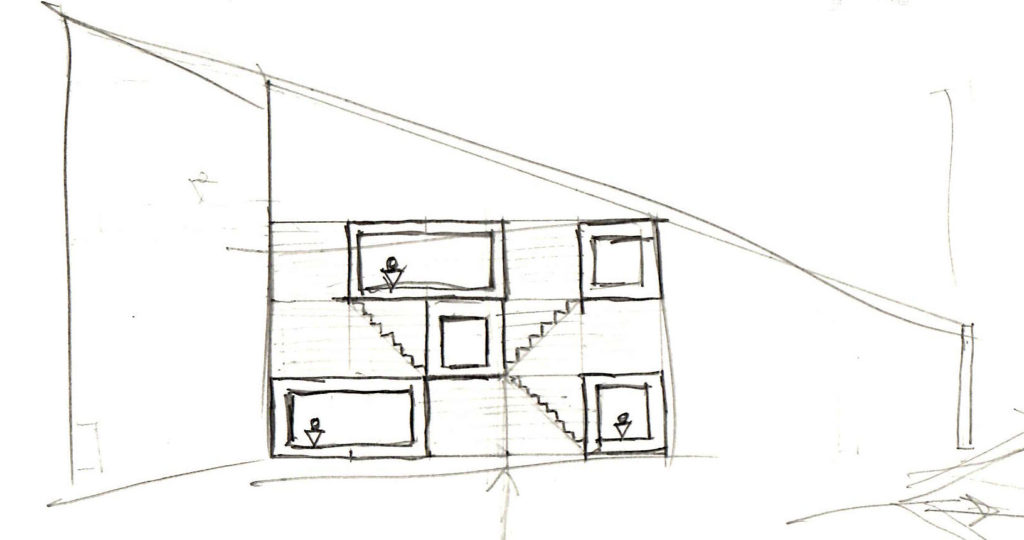
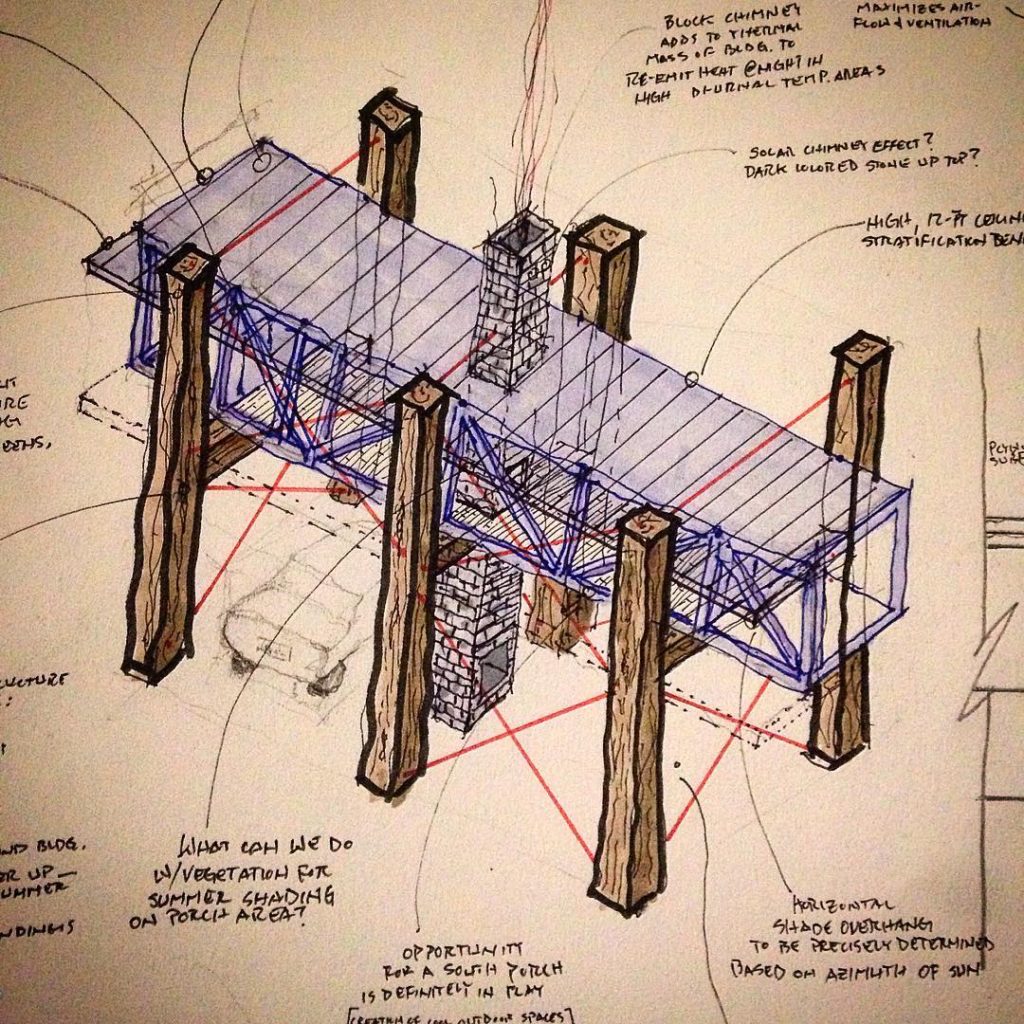
I’ve got a long way to go, but my point is that improvement is inevitable if you just stick with it. Sketching, like technical drawing, is a learned skill. Suffer through getting started, stay the course, and I promise you’ll be glad you did. I recommend practicing at least 20 minutes every single day. Every single day. Every. Single. Day.
Sketching for communication and problem solving
After enough practice you’ll eventually sketch not only for fun and to explore form, but also – on a highly practical level – to solve problems and communicate intent. At my desk at work I always have a sketch pad and pen immediately accessible. As I’m assembling technical drawings in Revit, I’ll often need to sketch something out by hand to figure out how I’m supposed to hard-line it in the CD set. I do this all the time. It’s helpful, and it works.
Sketching is also a great way to communicate in an architecture office. I frequently discuss things with coworkers that are complicated and difficult to put into words. When this happens, we’ll sketch what we’re trying to verbally explain, and usually that quickly clears up misunderstanding. A picture is worth 962 words.
I do a good bit of structural coordination at my firm, and sketches are invaluable in the back and forth communication here. I hand-sketch concepts and details for the structural engineer to review and vice versa. It’s way faster than hard-lining something you’d like to discuss in a drafting program.
The point I’m trying to make is that, although sketching is not necessarily a required skill for landing a job, it’s a practical skill that can be very useful at work.
Summary
You need to be proficient at technical drawing to be an architect, but this is a skill you learn in school. Sketching ability is not required to become an architect, but it’s an extremely useful skill that could greatly benefit you and your work. If you want to be an architect, and you can’t draw right now, that’s not a legitimate reason to not pursue the profession. In the immortal words of Nike, just do it mother fucker.